
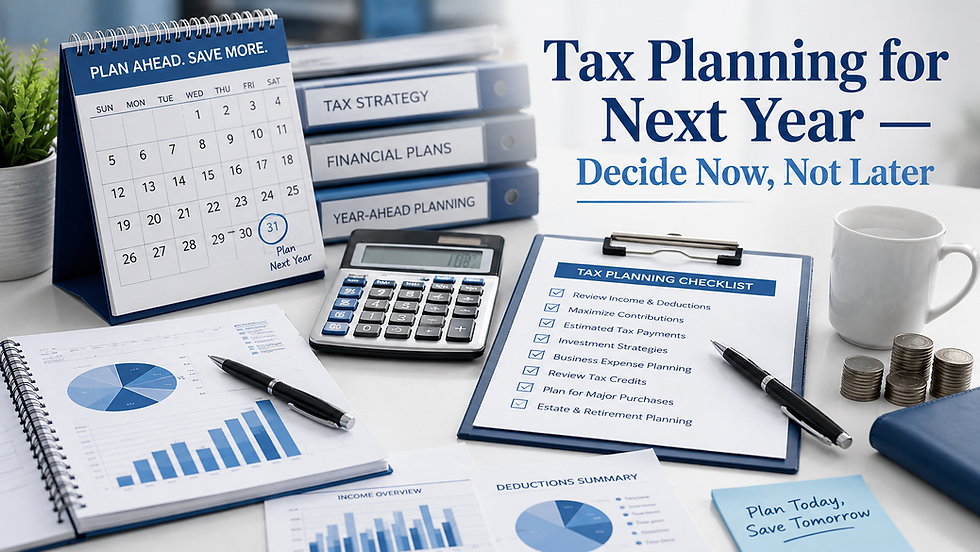
Tax Planning for Next Year — Decide Now, Not Later
It's August, and the year is heading into the home stretch. While it feels like tax time is far off, the truth is this: the best time to plan your taxes is right now.
Why? Because you still have several months to actually make moves. You can max out retirement contributions. You can time business expenses strategically. You can accelerate invoicing or defer it. You can evaluate your business structure. You can plan for bonuses, distributions, and draws. You have leverage. Once the calendar turns to January, you have none.
What Is Tax Planning, Really?
You hear accountants talk about it all the time, but what does it actually mean? Here's the simple version: tax planning is making intentional decisions right now that will reduce how much you owe later. It's not filling out forms and hoping for the best — it's strategy.
Most people think taxes happen in April. They file a return, pay what the IRS says they owe, and move on. But that's reactive. That's not planning — that's just reacting to what already happened.
Real tax planning asks harder questions. Should your business be structured as an S-Corp or an LLC? When should you recognize income and when should you pay expenses? What deductions are you leaving on the table? Should you max out a retirement account? Do you have capital gains you can offset with losses? Are you paying yourself enough from your business to maximize retirement contributions?
What Smart Businesses Do in Q4
Retirement accounts. SEP-IRA? Solo 401(k)? Regular 401(k)? The deadline is December 31 for most of these. Contributions you make in December reduce your taxable income for the year. Skip this, and you leave free money on the table — often thousands per year.
Business structure review. If you're making decent money and structured as a sole proprietor or standard LLC, you might owe 15% more in self-employment taxes than if you elected S-Corp status. This conversation takes an hour. The savings can be thousands per year.
Strategic timing. Can you defer invoicing to January? Can you accelerate purchases to December? Both move money between years and can lower this year's tax bill — but only if you're intentional about it.
Capital gains and losses. If you have investments, real estate, or cryptocurrency, you can harvest losses in December to offset gains. This is especially powerful in a good year.
Deductions and credits you might have missed. Educator expenses, home office, vehicle mileage, meals, supplies, subscriptions — small businesses leave thousands in deductions on the table simply because nobody sat down and asked, "What did we actually spend money on this year?"
What CenterPro Does for Q4 Planning
We review your income and expenses so far this year, then project where you'll end up. We run scenarios — what if we paid a bonus? What if we maxed out a SEP-IRA? What if we made this purchase now instead of January? We identify the moves that actually save you money, then we execute, filing strategically and helping you implement the plan.
The math is simple: one hour of planning in December can save you hundreds or thousands in taxes. Good planning can reduce your tax bill by 15-30%, depending on your situation. That's not a guess — that's math.
Ready to stop reacting and start planning? Let's talk. Not sure how this affects you? Let's talk
.


Comments